
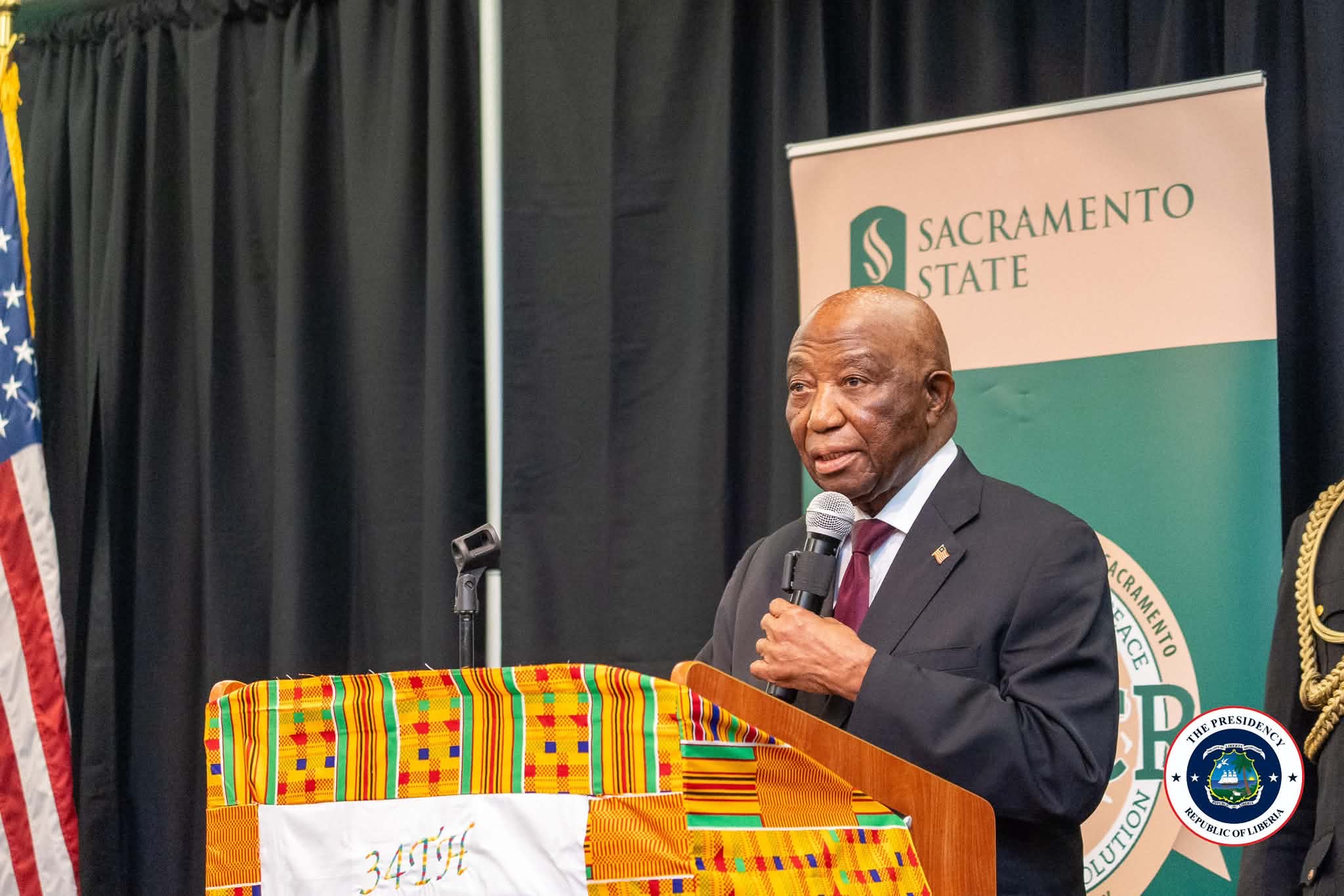
KEYNOTE ADDRESS BY HIS EXCELLENCY JOSEPH NYUMA BOAKAI, SR.
PRESIDENT OF THE REPUBLIC OF LIBERIA AT THE 34TH AFRICA PEACE AWARDS
CENTER FOR AFRICA PEACE AND CONFLICT RESOLUTION CALIFORNIA STATE UNIVERSITY SACRAMENTO, CALIFORNIA, USA
Click here to watch full video on facebook
Theme: “BUILDING THE NEXT GENERATION OF PEACE LEADERS IN AFRICA & HER DIASPORA”
Dr. Luke Wood, President of California State University, Sacramento;
Dr. Ernest Uwazie, Director of the Center for African Peace and Conflict Resolution;
Members of the Board, Faculty, and Administration;
Members of the Diplomatic Corps;
State and Municipal Officials Present;
Leaders of the African Diaspora;
Members of the Liberian Community in Sacramento and the Larger Liberian Community Organization, ULAA;
Students;
Distinguished Ladies and Gentlemen;
My Dear Friends;
Distinguished Guests;
Ladies and Gentlemen:
Good evening,
I stand before you today with deep humility and profound gratitude as I accept this distinguished Peace Award. I thank the organizers, the selection committee, and all those whose commitment to peace has made this moment possible.
Let me also thank California State University, Sacramento, and the Center for African Peace and Conflict Resolution for this honor. I am privileged to follow in the footsteps of eminent African statesmen, women, and peace leaders whose legacies continue to shape our continent.
This honor is not mine alone. I receive it on behalf of the resilient people of Liberia, men, women, youth, and children who endured conflict and emerged with an unyielding commitment to peace, reconciliation, and renewal.
Distinguished Guests,
Peace is often spoken of as an ideal, something noble and aspirational. But for us in Liberia, peace is not abstract. It is lived. It is earned. It is protected every single day.
Our history reminds us of the devastating cost of conflict. Between 1989 and 2003, Liberia experienced a civil war that claimed over 250,000 lives and shattered our institutions. Families were broken. Trust was eroded.
Yet even in our darkest hours, the Liberian spirit did not yield. We chose reconciliation over revenge. We chose dialogue over division. We chose hope over despair.
Dear Friends,
The journey from conflict to peace is never easy, and it is never complete. Peace is not merely the absence of war. It is the presence of justice, opportunity, and dignity for all.
I was born in a small village in Lofa County. As a young boy, I could never have imagined standing before you today. My early life was shaped by hard work, discipline, and the belief that education and service can transform destiny.
Those experiences taught me a lasting lesson. Peace begins with the individual. It begins in our homes, our communities, and in how we treat one another.
With the Accra Comprehensive Peace Agreement in 2003, Liberia began its journey toward reconciliation and democratic renewal. Step by step, we rebuilt institutions and restored governance.
Today, we confront our past with honesty. We have conducted dignified reburials, issued a national apology, and are working to establish a War and Economic Crimes Court so that accountability and reconciliation move forward together. More importantly, Liberia has experienced several peaceful democratic transitions, thereby consolidating our democratic credentials.
All of this has become possible because we believe that sustainable peace must rest on fairness, inclusion, and respect for the rule of law.
Distinguished Guests,
Across the world, we continue to see instability, conflict, and emerging threats. Violent extremism, climate pressures, and inequality challenge global peace.
These realities remind us that peace must be continuously protected. No nation is too small to contribute. No voice is too quiet to not matter.
Liberia’s journey demonstrates transformation. Today, we serve on the United Nations Security Council for the 2026 to 2027 term. We will use this position to promote dialogue, strengthen diplomacy, and advocate for cooperation.
How can Africa build the next generation of Peace Leaders at home and abroad? Africa’s next generation of leaders must go beyond simply ending conflicts to aggressively preventing them.
In a world where worthy examples are scarce and with about 70 percent of Sub-Saharan Africa’s population under the age of 30, we face a demographic reality that presents both an opportunity and a serious risk. It can also serve as a powerful engine for peace, innovation, and development, or, if neglected, can become a source of tension, fragility, and conflict.
Civil wars, global conflicts, severe global economic shocks, climate pressures, youth unemployment, and social inequality have increasingly subjected our youth to negative values, manipulations, and exploitations.
Across our continent, young people remain marginalized, facing limited access to education, employment, and opportunity. This marginalization has driven many to seek better prospects abroad, often risking their lives across the Sahara and beyond, while others fall prey to criminal networks, illicit drugs, human trafficking, and other negative influences.
This reality of doom must change! Governments and national leaders must ensure that the aspirations, energy, and potential of young people are fully integrated into governance and development processes.
To this end, please permit me to offer some thoughts:
1. Governments in Africa must undertake deliberate and bold measures that support universities and regional bodies like the African Union and ECOWAS to invest in leadership initiatives, especially fellowships and mentorships to encourage and mentor young people;
2. We must rethink our philosophy of education, integrating new ideas that connect youths to service and patriotism, and undertake formation programs that alter the historical marginalization of our youths. Our schools’ curricula and other pedagogic networks must incorporate programs on peace education. From primary schools to universities, young people must be taught courses on peace building, conflict resolution, civic responsibility, and critical thinking.
3. We must work with young people to leverage technology positively. Digital platforms must be used to mobilize, advocate and educate, promote dialogue, counter misinformation, and build cross-border solidarity.
4. Traditional youth organizations like the YMCAs, other youth and student organizations must be restructured to integrate programs on peace mentorship, establish peace movements, school peace clubs, mediation initiatives, youth parliaments, etc. This can enhance inter-generational partnership.
Our continent, Africa, is blessed with diplomats, traditional leaders, elders, women, and civil society actors who cannot retire but transfer wisdom to our young people.
We must transform our vast natural wealth into prosperity and opportunities for our youth, and adopt policies that prioritize youth inclusion and empowerment.
We must ensure that Africa’s demographic dividend translates into productivity, innovation, and shared prosperity, not into a restless and disfranchised population vulnerable to instability.
Peace leadership must ensure justice, inclusion, accountability, and dignity. Peace is not the absence of conflict. It is the presence of fairness and opportunity. If the young people of our continent do not see justice, they will not believe in peace. Strong institutions that reward ethical leadership and platforms that amplify youth voices in governance must be supported.
My Dear Friends,
Africa and her diaspora share a common destiny, one rooted in resilience, shared heritage, and collective aspiration. The vestiges of slavery, colonialism, imperialism, civil wars, and autocratic rule crippled Africa’s growth and severely diminished its human capital. Some of our citizens fled into exile, but this must not be our fate. The diaspora can now become an integral part of our reconciliation and development. Victims of today must discourage the repeat of their torture. Be different and reconcile!
Peace leaders are not only presidents and diplomats. They are teachers, community leaders, entrepreneurs, and citizens who refuse to allow hatred to define their future.
Our Continent, Africa, is enjoying a measure of political freedom, but like all other freedoms, it means we are free to choose whose slave we want to become. In choosing new masters, we must be careful and guide against the vain accumulation of wealth and power that seeks to marginalize and degrade others.
You, our youth, are the custodians of today’s and tomorrow’s peace.
Do not underestimate your power! Do not underestimate your voice! Leadership is defined by purpose!
Choose to build bridges!
Choose justice!
Choose peace in every space you occupy!
Distinguished Guests,
I am particularly pleased that this Center collaborated with the University of Liberia during the 1990s, helping to train Liberian officials and practitioners in conflict transformation during one of the most difficult periods of our national history. Those efforts contributed to Liberia’s recovery and continue to influence how we approach reconciliation today.
In Closing, I accept this Peace Award with humility, but also with renewed commitment. This is a commitment to continue working for a Liberia that is just, inclusive, and prosperous; a commitment to contribute to peace across Africa and the world and a commitment to ensure that the sacrifices of the past are never forgotten.
Let us move forward together, with faith, with purpose, and with unwavering dedication to peace. And finally, I ask that you seek peace and pursue it.
Again, I thank you. May God bless you all, and may God bless the cause of peace.
To read the full piece from Executive Mansion, click here.
 Send by email
 PDF version